Crop Research


California Tomato Research Institute
18650 Lone Tree Road
Escalon,  CA  95320


2011 Sponsored Research


Mission Statement

Founded in 1968, The California Tomato Research Institute, Inc. is a non-profit organization of processing tomato growers. As the industry's research sponsor, the Institute's purpose is to identify, fund and direct research to maintain and enhance the economic viability of California's processing tomato industry with emphasis on production, product quality and the environment.

The CTRI program is comprised of short and long term projects

Crop Production Project Objectives 

  • Focus on Limiting Factor Management
  • Improve Monitoring, Diagnosis & Decision System Improvement on:
    • Diseases, Insects, Weed Management, Crop Nutrition, Irrigation
    • Represent industry on crop regulatory issues
    • Facilitate commercial product development by providing researcher coordination, field trials and market analysis,
  •   Variety Improvement Projects
    • Focus on improving consistent Yield & Quality
    • Statewide Field Trials
    • Molecular Marker Development of Disease and Insect Resistance
    • Soluble Solids Enhancement
    • Heat Set Ability and Salinity/Drought Tolerance Cooperative Projects
    • Alliance with the California League of Food Processoron crop quality improvement projects
    • Formation of funding partnerships beneficial to growers,with other agencies


 2011  Projects 

Agronomic Research

Evaluating drip irrigated double-row tomatoes on 80-inch beds - Scott Stoddard, Tom Turini - Full enterprise evaluation of 80 inch cropping system, continued from 2009.

Irrigation and Salinity Management for High Yielding Processing Tomato Systems – Tom Turini, Dan Munk - Continuation of work to improve grower application of  established salinity management concepts with recent changes to transplants, drip, and newer varieties.  Normally this type is work is done at the research station, but due to project scale and grower interest it is in a commercial field.

Use of Daikon Radish Cover Crop and Reduced Tillage to Alleviate Soil Compaction Effect and Nitrogen Retention in Processing Tomato - Guihua Chen - Support for work at the Russell Ranch Sustainable Ag Facility at UC Davis.   The project has local interest and is applicable directly to higher rainfall areas, subject to nitrogen leaching.

Statewide Variety Trials – Scott Stoddard (All Farm Advisors) - A continuation of the widely used independent source of variety information for growers. 

CM Rick Tomato Genetics Resource Center - Roger Chetelat - Annual support of the valuable germplasm bank.  The Center serves as a warehouse for genetic materials and often a seed source for research projects. 

Disease Management

Tomato Powdery Mildew Control – Brenna Aegerter - A continuation of a series of field trials in major growing areas by five Farm Advisors to evaluate spray programs for control of the evolving, more aggressive mildew strains

Tomato Spotted Wilt Virus (TSWV) Analysis and Management – Bob Gilbertson - Continuation support for a statewide effort to predict and manage the virus, serving problem areas such as Fresno, Merced and Colusa counties

Improved Resistance of Ripening Tomato Fruit to Pathogens - Ann Powell - Final year of Coordination with a larger National Science Foundation project on Botrytis mold.  CTRI funds were used to evaluate the gene effect on other California specific molds.

Development of a Virus IPM Strategy - Bill Wintermantel -  Continuation of a site specific virus transmission study starting initially with curly top virus and encompassing other insect vectored viruses.  Preliminary work to gain USDA support for development of a larger multi-crop, comprehensive vectored disease management program.  

Field Evaluation of Grafted Tomatoes - Gene Miyao - Greenhouse tomato production, watermelon and a few other specialty crops have begun to utilize grafting to deal with disease problems.  While currently cost prohibitive, the research will help lay the groundwork for possible use or at least evaluate the losses to various soil diseases.

Harvester / Equipment Movement of Fusarium Oxysporum - Gene Miyao -
A small scale start on a CTRI research priority to define the transmission of soil disease by contaminated equipment.  

Screening Promising Germplasm for Resistance to Bacterial Speck and Monitoring P. syringae Strains - Gitta Coaker -
This past year saw a resurgence of speck related problems.   The project seeks durable new resistance and closer monitoring of current disease strains.

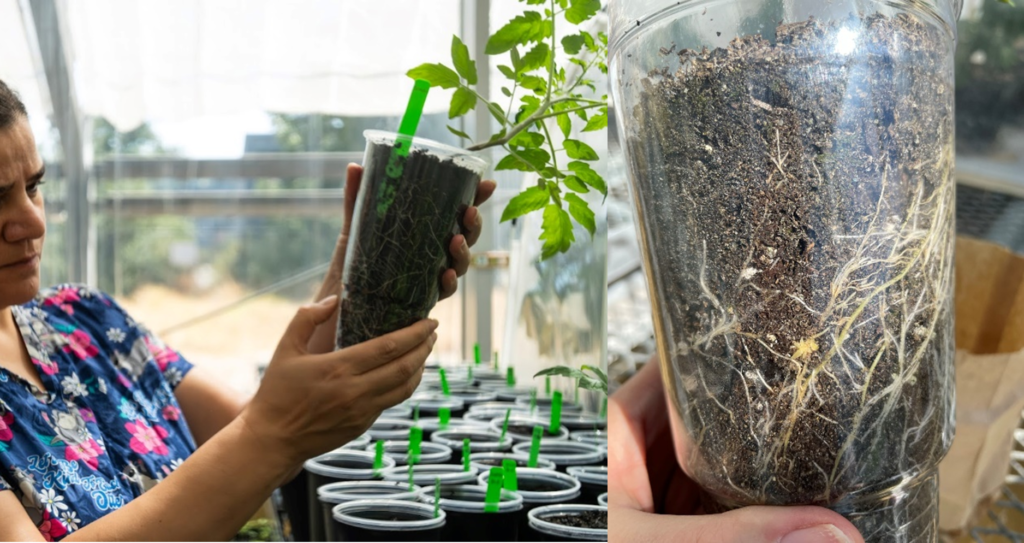
Influence of Drip Irrigation on Tomato Root Health - Mike Davis & Johan Leveau -  A requested proposal to address the decline over time in productivity of drip irrigated fields.  The work will measure a wide range of root/soil components along with salinity and productivity.  

Evaluation of Fungicides, Bio-Pesticides and Soil Amendments for the Control of Southern Blight of Processing Tomatoes - Joe Nunez - Southern blight is an old disease, primarily from prior sugar beet rotations, but resurging under drip irrigation .  The proposal is refinement and continuation of work started in 2010.

Host Range of Fusarium oxysporum f. sp. vasinfectum race 3 in cotton - Mike Davis
Co-funding with the cotton industry this to better understand the evolving races of several Fusarium species.  

Nematacide Screening in Processing Tomato - Joe Nunez, Ole Becker, Antoon Ploog - Replicated trials using conventional and organic products to control root-knot nematodes


Weed Management

Field Bindweed Management in Processing Tomatoes  – Tom Lanini - A continuing proposal refocused to bindweed control. Tom continues to be the only department researcher regularly working on tomato.  Bindweed continues as our most difficult to control weed.  Especially problematic in regions where crop rotation does not provide an adequate opportunity to treat.

Within Row Weed Control System for Transplanted Processing Tomato  - David Slaughter - 
Weeds continue as the major pest expense.  The proposal tests the feasibility of a low cost system for within row weed control.  It’s an interesting concept and readily usable if the loss of crop plants can be kept low enough.  That is the primary question the proposal seeks to answer.